
Introduction to Malawi
What can I say about the country of Malawi? I can call it a beautiful country, a very poor country, a country famous for its friendly people – all these would be true. Look at the (brief) information contained on this site, visit the link sites, but better still – go and visit the country yourself…
What you’ll find on this page about Malawi.
Information about Malawi:
- Population
- Economy
- Geography
and this page features some sample news-clippings ‘borrowed’ from local newspapers!
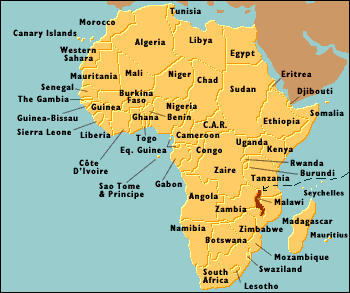
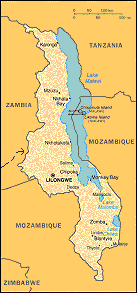
Malawi Population: 11 million and rising
With a quarter of its total land mass taken up by its lakes, Malawi is one of the most densely populated countries in Africa. About 80% of people still live in the villages, with the remaining 20% in the larger urban areas of Blantyre, Lilongwe and Zomba. Indeed, Blantyre has an estimated 10% of the population alone.
Unlike many other African countries, it is difficult to travel any distance without seeing some evidence of human dwellings. One per cent of the population is non-European, coming from Asia or Europe.

Malawi Geography
 Malawi is one of the smaller African nations – some 900km long and between 80 and 160km wide. It neighbours Zambia to the west, Tanzania to the north, and Mozambique which curls round the eastern side of Malawi.
The dominant feature of Malawi is Lake Malawi, an enormous lake – 12th largest in the world, and 3rd largest in Africa – officially classified as an inland sea. The lake lies in the deep trough formed by the southern portion of the African Rift Valley as it runs through Malawi.
Mulanje Massif contains the highest peak in Malawi (3000m), and lies in the south-eastern corner of Malawi. Other high-lying areas include Zomba Plateau (2100m) in the south, and Nyika Plateau (2600m) in the north. The lowest point in Malawi – and probably the hottest – is the lower Shire Valley, which gets as low as only 37m above sea level (lower than the lake)
The tropical climate consists of 3 seasons: the hot-wet (November to April), cool-dry (May to August), and hot-dry (September to November). As with most weather patterns around the world, the seasons seem to come later and later each year. Temperatures vary from freezing (high altitudes) to 38oC (the lowest altitude).
Malawi Economy
Malawi’s wide range of climactic conditions have lead to the development of such tropical and subtropical crops as maize, tobacco, sugar, cotton, groundnuts, timber, tea, coffee, rubber. The quality of tea and tobacco is world-class, and so these crops are the main ones used for export.
Tourism is another major earner of foreign exchange.
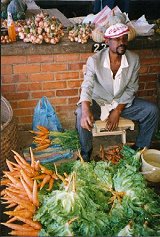
More Little Differences
- In UK it’s a frail sunshine engulfed by a pervasive murky grey; whilst here in Malawi we have a vigorous gladiatorial sun: big, bright and burning!
- In UK I’m just an ordinary bloke; but over here I’m this rich mzungu – gold-filled pockets, the finest clothes, the most exclusive of residences.
- In UK it’s 4 to a taxi; but in the squashed, squeezed, hurly-burly of Malawi it’s always: “Room for 4 more!”
- In UK you say “OK?” to a stranger, your reply is a cold suspicious silence; in The Warm Heart of Africa, a friendly greeting returns many happy retorts.
(You can read more about the differences I spotted in this diary entry!)
NOTE: 2025 Editorial – Malawi news clippings removed
For sake of time, and relevancy, I’ve removed the clippings from Malawi News (1995 to 1997) that I previously put on this site.
If you want to read ’em, you can do so on the original site.
And if you want an up-to-date, Malawian perspective of Malawi, why not check out this ‘visit Malawi’ website: Malawi Tourism